
Walking Through the Valley: A look a Psalm 23

The Lord is my shepherd; I shall not want.
He makes me lie down in green pastures.
He leads me beside still waters.
He restores my soul.
He leads me in paths of righteousness
for his name's sake.
The first stanza of Psalm 23 captures our hearts, doesn’t it? It’s balm for the soul. It’s essentially the heart and soul- the mantra of care in the church.
“The LORD is my shepherd, I shall not want.”
There is so much hope to be found for ourselves and anyone we meet with in that first stanza. This is where we want to find our dwelling place all the days of our lives. It’s the foundation from which we build everything else we do. We want all of our actions and words to come from living in this place. The sweetness and the hope that the Lord is my shepherd, therefore I shall not want. He makes me lie down in green pastures. He leads me beside still waters. He restores my soul. He leads me in the paths of righteousness for his name’s sake.
Just as true, however, is our lived experiences that often clash with these promises.
Many people read a psalm like this and are hit with a wave of shame because they have experienced everything except God’s provision, peace, refreshment, protection, comfort and justice.
Instead, they feel rejection and abandonment.
They can't make sense of their lived experience and what they’re reading. They read Psalm 23 and have so many questions, but it often feels wrong to vocalize them.
Where was he? Does he hate me? Was I too wicked for him to be near me? Am I even saved? Why did he want me to suffer so much?
They bridge the gap by concluding that He is the Good Shepherd, but that applies to everyone else, but not me.
So, how do we help people bridge the gap differently? To help them experience these greener pastures, where they know these things to be deeply true in their souls, during all the days of their lives- the good, the hard, the terrifying, the unknown? How can these words really be of comfort for themselves.
The pathway for us is right there in verse 4.
“Even though I walk through the valley of the shadow of death…”
Our hope is located in the truth that it's actually through our sufferings- through the things we experience in life that the Lord is bringing near his promises.
I run a group called Storied Lives, where we write and share stories of our past that hold confusion, shame, betrayal, powerlessness, and the like. In group, we often talk about the space where we all live as we await Christ's return—the space between Good Friday and Easter Sunday. It's Holy Saturday. It’s the day after Jesus walked through his valley of the shadow of death. And It’s the time when the Disciples began to walk theirs.
Their hopes and dreams were on the line. They were confused about what just happened the day before. Everything they had thought was true was up in the air and so they hid for fear of what might happen to them next.
I think if we were honest, we all find ourselves living in Holy Saturday.
We feel as though what we hoped for in life has not come to fruition. We’re confused by our experiences and afraid of what might happen to us.
The valley of the shadow of death.
U- Diagram
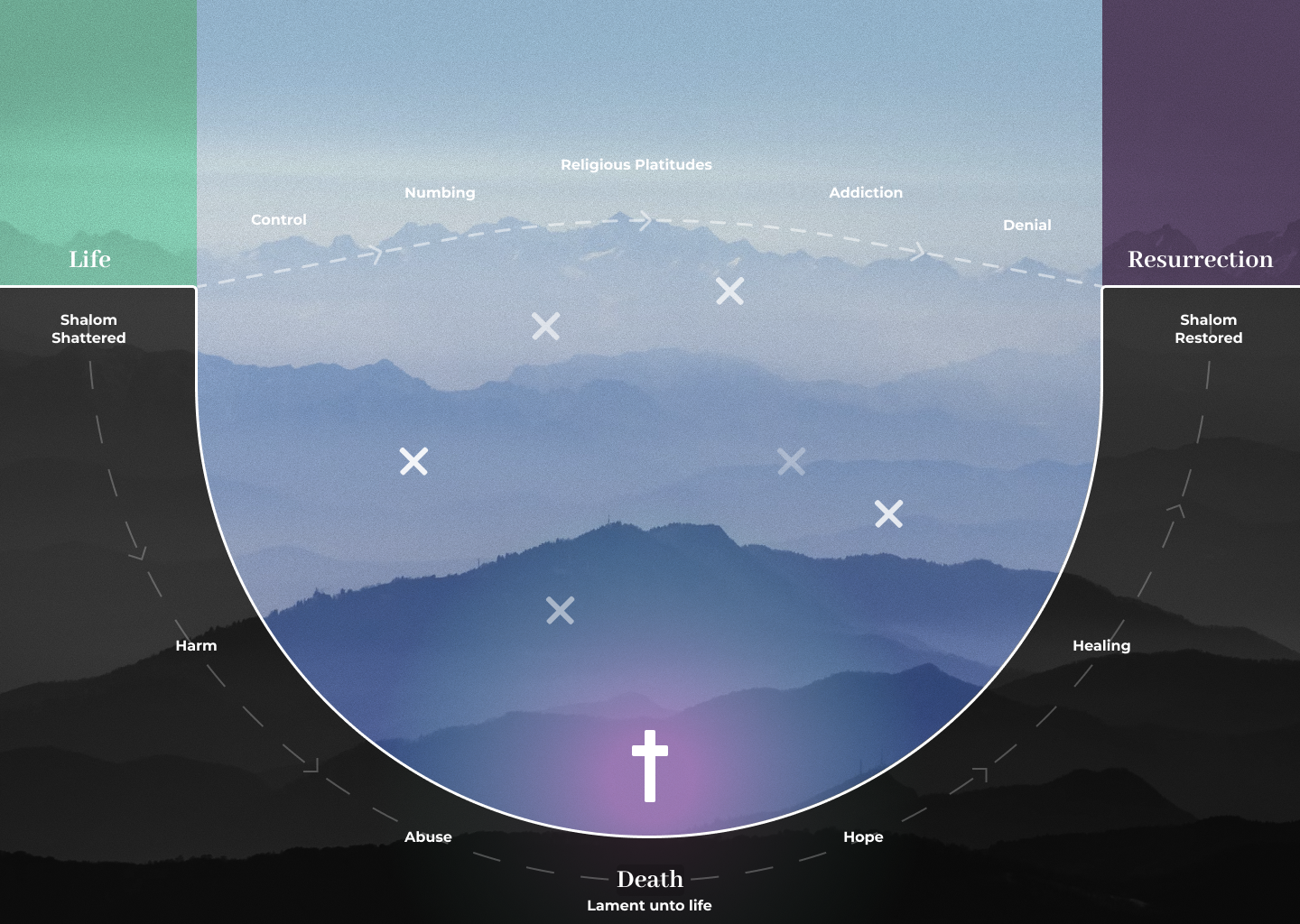
Dan Allender has a diagram of healing called the “U-Diagram” that gives us a visual for Psalm 23 and our sojourn through from death to life.
Let me show you a visual and then we will walk through each section.
Life
Life is where our stories begin to have Shalom shattered, where the garden didn’t happen. It’s easy to compare our stories to other people’s and say it wasn’t that bad compared to …… but what we really need to be comparing our stories to is Eden. Anything that was not Eden is a form of a trauma because it’s when evil began to break into our stories.
The x’s are stories of the past and stories in the present. Little deaths, losses, real death, terrible brokenness, stories of betrayal, powerlessness. It’s the stories of confusion and hope being dashed. It’s where we have made vows to keep ourselves safe, where we’ve cursed our stories/bodies because we feel such shame and contempt and ambivalence.
Experiences where we didn't feel seen, known, loved. Where we walk away wondering if anyone cares, if things will ever be different. Stories where we have concluded that we are the problem, the reason for our suffering. Where we carry the weight of not being enough or being too much. Where we conclude that we don’t belong and wonder what our purpose even is.
Jumping the gap: ways we try to experience resurrection
We all want to avoid walking through the shadow of the valley of death. Addictions, pornography, denial, dissociation, doom scrolling, religious platitudes are all ways we try to jump the gap to experience shalom.
Our stories have felt so much like death, that we can't go down into them, so all we have is to deny and numb ourselves out, or escape with addiction or busyness.
These aren’t congruent with Holy Saturday where we sit in grief. I think it’s often an unconscious path that we have taken out of survival or because of examples we’ve learned from. Because of that, we can be really gentle and gracious towards ourselves and other people who have survived life by attempting to jump over this gap, in the hopes it will get them to shalom restored.
But Death wants us to ignore these stories. And in our current age, it doesn't have to work very hard to get us to ignore it, does it?
Evil wants to keep us at death- death without grief. But Jesus invites us to grief unto life.
With death there is no movement. Grief has movement- maybe slow and circular, but there is movement.
Our call as followers of Jesus is to actually walk with our counselees and friends and church members through the valley of the shadow of death. We dive down with them into the stories that feel like death, that feel like they might fall apart, so they don't have to do it alone. This is the path Jesus took. Because Jesus was the forerunner, we know that we won’t meet death when we get closer to these stories. We dive down with people into the places where God has prepared a table before them in the presence of their enemies. But we don't face it alone. We face it with one another. We name it. We look it in the eye. In the presence of our enemies.
Buoys
God offers us buoys as we go into the deep waters of our experiences. We are often one of the buoys God has provided for people.
Jesus was the only one who was perfectly able to live out Psalm 23. He knew without a shadow of a doubt that His father was with him.
But we often only feel his rod and his staff trying to comfort us. So God graciously has given us buoys, where we can dive down in the pain for a minute then come back up for a breather. Other buoys might be our community, our faith, our imagination of what could be, overcoming fear- recognizing that you didn’t crumble in the face of pain. That is what experiencing Jesus’ resurrection power/healing often looks like.
Lament
One of the most important things for us as we step into these stories is to lament. And these buoys, our community, our presence with one another enables us to do this.
“Lament is letting God in on what is, so that He can bear it too. ”
It’s not trying to solve the problem.
Scripture is full of lament. Jesus didn’t skip over, He went down. He invites us to allow him to carry the sorrow, the pain and the burden.
Lament can become the song we sing when we are entering into death.
Resurrection/ Shalom
“You anoint my head with oil; my cup overflows. Surely goodness and mercy shall follow me all the days of my life, and I shall dwell in the house of the LORD forever.”
We see in the Psalm that David turns from speaking about the Lord to speaking to the Lord himself. “He makes me… He leads me… He restores me…” To “you are with me… You prepare… You anoint…”
And how does God respond to the one who turns and speaks to him directly? With a feast.
David Gibson in his book, the Lord of Psalm 23 quotes W.S. Plummer, “to prepare a table was to make ready a feast. It was more than to give a loaf of bread to a weary pilgrim. It was to detain one as a guest and set before him the best of everything that could under the circumstances he had.” I love this imagery of detainment because it’s often what we feel in life, right? Detained, held back, missing out, powerless.
But because Jesus has gone before and his death has led the way to life, the detainment is being flipped into blessing. Resurrection to our stories.
He is laying the feast before us. Preparing a table. Anointing our head with oil, which Gibson points out this is not a ritual anointing, but a being or growing fat. So you make my head fat with oil. The sense is simply of the liberality of the host; the provision is lavish and rich, not meager or minimal. He’s overflowing my cup.
In his book, The Lord of Psalm 23, David Gibson says,
“A table, with food and drink, is where covenants can be sealed and fellowship formed, it is where relationships can be restored and enemies reconciled as friends…”
“The greatest of hosts himself prepares the most lavish of feasts for the lowliest of creatures. How amazing it is that the Lord of heaven should be seen here spreading his fame in all the earth by wanting to be known as a certain kind of host… It is in God’s nature to serve us as much as it is to save us.”
This is what grieving unto life means, where suffering with his power leads. Shalom is restored. People’s experience of their story changes when they lament- when they let God’s compassion meet them in the pain. They start to see themselves differently.
Where they once saw themselves as stupid for loving and trusting their dad who left them, they can see that child in their story as sweet for naturally loving their parents. Where they felt cowardly, they begin to see that they actually had a lot of perseverance and resolve.
They can bear having people look at them and not feel the need to hide behind a chair or slump their shoulders in shame.
They can find joy and forgiveness.
Vows they made to keep themselves safe start to lose their allure. We start to see freedom from addictions because we can say, “The Lord is my shepherd, I shall not want.”
Yet, we don’t want to force shalom onto people. We have to humbly admit that we don’t actually know what God has in store for this person’s story on this side of heaven.
Our call is to be curious with them and watchful and present. Give them the gift of your presence.
This isn’t a path of teaching Biblical truths, because that can be demeaning and diminishing to their felt experience. Instead, this is going with them down the path Jesus took to honesty and lamenting the losses and pains in life, bringing them to the Father to bear it with them.
We want to be emphatic witnesses to their stories so that they can see through our faces, the face of the host.
Sometimes this looks like having faith for them- knowing, for them, that the Lord’s goodness and mercy are following them all the days of their lives.
One day, they will dwell in the house of the Lord forever, even if their entire lives feel like Holy Saturday and never Resurrection Sunday. That takes a lot of courage, doesn’t it. To sit in the discomfort and not have a solution- Even when as Christians, we know what the solution is, where the story is going. Can we let ourselves be so immersed in their Holy Saturday, and so trusting that the Lord will provide, that we sit in grief longer than feels comfortable for us.
The feast has been laid, the covenant has been sealed.
I want to thank my friend Carrie Sinsabaugh for her leadership in Storied Lives over the past 10 years. So much of this has been developed from the hard work she has done to develop our teachings for Storied Lives.
If you are interested in joining our 2026-2027 Storied Lives cohort or wish to learn more about how this could be apart of your sojourn, please feel free to reach out for more information or for our application at Kaylin@sojournersoulcare.com
For a more in depth teaching on this topic, you watch the break out talk I gave here.